

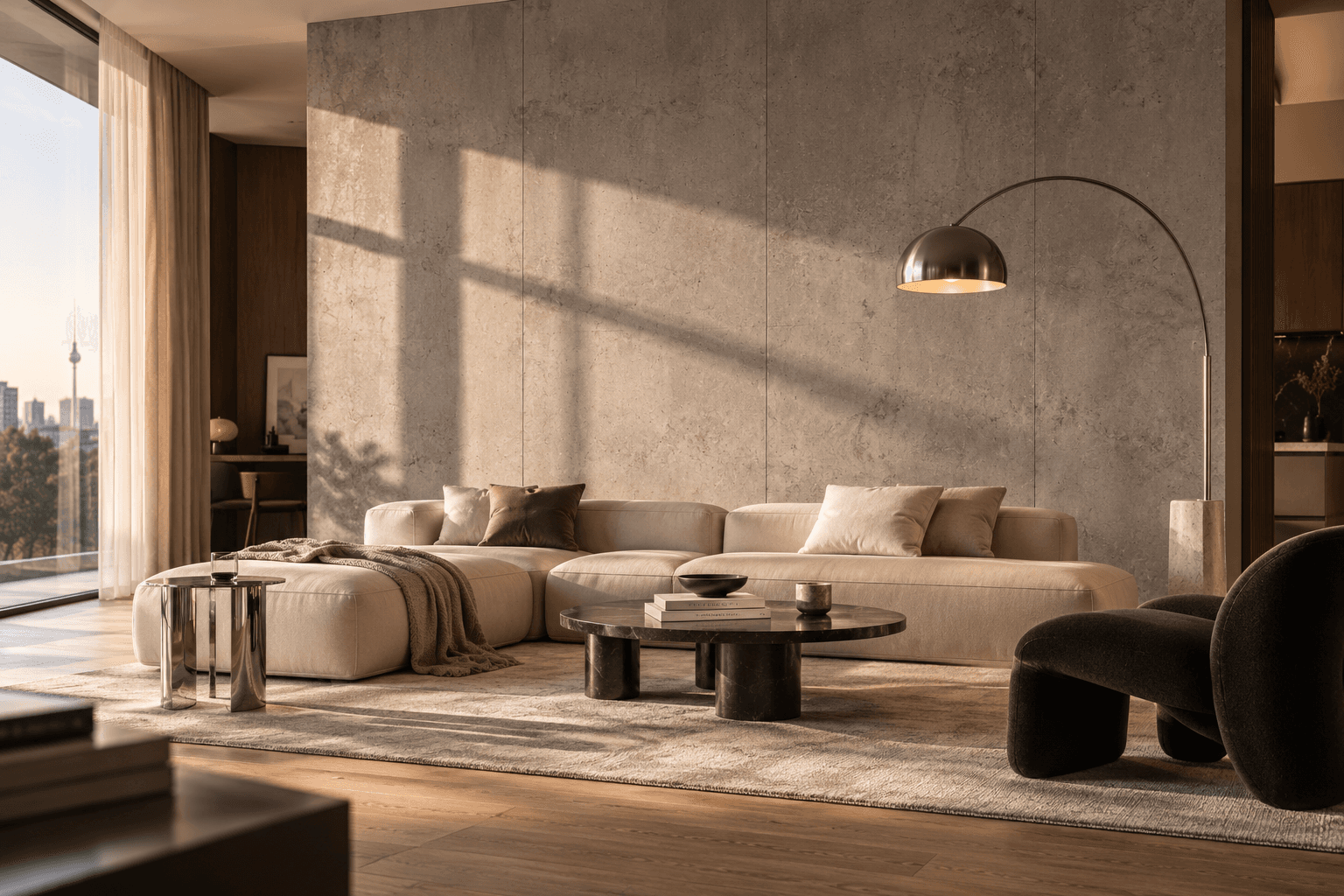
September 30, 2026
Living Room Accent Wall in a Concrete Look
Concrete in the living room was once a statement reserved for architects and loft dwellers. Today, the concrete look is one of the most-searched wall decors in German homes — because it achieves something few other materials can: calm and character at the same time. And because SPC wall panels make it possible without a building site.
Why concrete-look panels and not real concrete?
Real exposed concrete, concrete plaster or microcement are labour-intensive, expensive and very difficult to correct. A microcement application in Germany costs between €80 and €180 per square metre in labour alone. And if the result does not look right, painting over it is not an option.
SPC wall panels in a concrete look cost a fraction of that, can be installed in a day, and can be removed without a trace if you move or change your style. The visual difference from real concrete is not detectable from a normal distance in a living room — the texture, the subtle irregularities, the gentle colour variation are all there.
The accent wall principle
An accent wall — also called a feature wall — is a single wall surface that defines a room's character without overwhelming it. This works for a simple reason: the eye looks for a focal point. A wall that differs from the rest gives the eye exactly that.
In a living room, the sofa back wall is the strongest candidate: it is the largest continuous surface, it falls in the sightline when entering the room, and it is not directly in view from the sofa position — meaning guests actually study the panels up close when they sit down.
Which wall to choose?
- Sofa back wall — the classic first choice. Strongest visual weight, maximum impact.
- Fireplace wall — the room's natural focal point. Concrete and a fireplace complement each other perfectly.
- TV wall — functionally logical; the concrete look acts as a calm backdrop for the screen.
- Hallway entrance wall — the first impression on entry. Particularly effective in narrow corridor-style hallways.
What to avoid: cladding two opposing walls in concrete-look panels. This creates a tunnel effect and robs the decor of its special quality.
Concrete-look decors: understanding the differences
Not all concrete looks are equal. The differences lie in colour temperature and the degree of weathering:
- Warm concrete — beige-greige tones, low contrast. Feels residential and close. Pairs with wood, leather, warm textiles.
- Cool concrete (cement grey) — the industrial original. Stronger contrast, cooler effect. Needs warm furniture as a counterweight.
- Weathered concrete — more surface variation, inclusions, subtle mottling. Feels more authentic, less polished. Ideal for rooms with character.
Our recommendation for living rooms: warm to mid-range concrete. Cool grey tones work in large, bright rooms — in smaller or north-facing rooms they can feel cold and uninviting.
What pairs with concrete-look?
The concrete look is not a backdrop — it is a partner. What it needs is material contrast:
- Warm wood (oak, walnut, smoked oak) — the classic counterpoint to concrete. Brings warmth back.
- Cream-white upholstery — sofa, armchair, cushions. Not pure white — that reads clinical. Greige, camel, sand.
- Chrome and nickel (steel, arc lamps, side tables) — complements the industrial origin of concrete.
- Dark accents (black coffee table, anthracite armchair) — sets a counterweight against the light surface.
- Natural stone — marble table, travertine base. A material kinship that intuitively feels right.
What to avoid: too many colours. Concrete as a backdrop works best in a palette of three to four tones. Introduce too much colour and the concrete wall loses its weight.
Planning: how many panels do I need?
SPC wall panels are sold by the square metre. Measure height × width of your target wall and add 10 % for waste (sockets, window cutouts, saw cuts). A typical German living room with a sofa back wall of 3.5 m × 2.6 m = 9.1 m² needs approximately 10 m² of panel material.
Our panels come in packs sized for standard room dimensions. When in doubt, order one pack more — panels from the same production run have identical colouring, which cannot be guaranteed on a reorder.
Frequently asked questions
Can I install concrete-look panels over wallpaper?
No. Wallpaper is not a load-bearing substrate for wall panels — the adhesive bonds to the paste, not to the plaster. Remove the wallpaper completely, check the substrate and smooth it if necessary, then apply the panels.
Are concrete-look panels easy to maintain?
Considerably easier than real concrete or microcement. SPC has a PU wear layer that requires no sealing and cleans with a damp cloth. Real concrete must be re-impregnated regularly and shows water marks unless wiped immediately.
Will the joints between panels be visible?
With correct installation, the click joints are barely noticeable — the decor runs continuously across the joint. For a fully seamless look, use a colour-matched silicone sealant. In a living room (no splash water), this is optional rather than required.
Can I also clad the ceiling in a concrete look?
Technically yes, but we do not recommend it for living rooms. A concrete ceiling above a concrete wall creates a very heavy spatial feeling. If you want to unify ceiling and wall, choose a lighter, quieter concrete variant for one of the two surfaces.
More articles
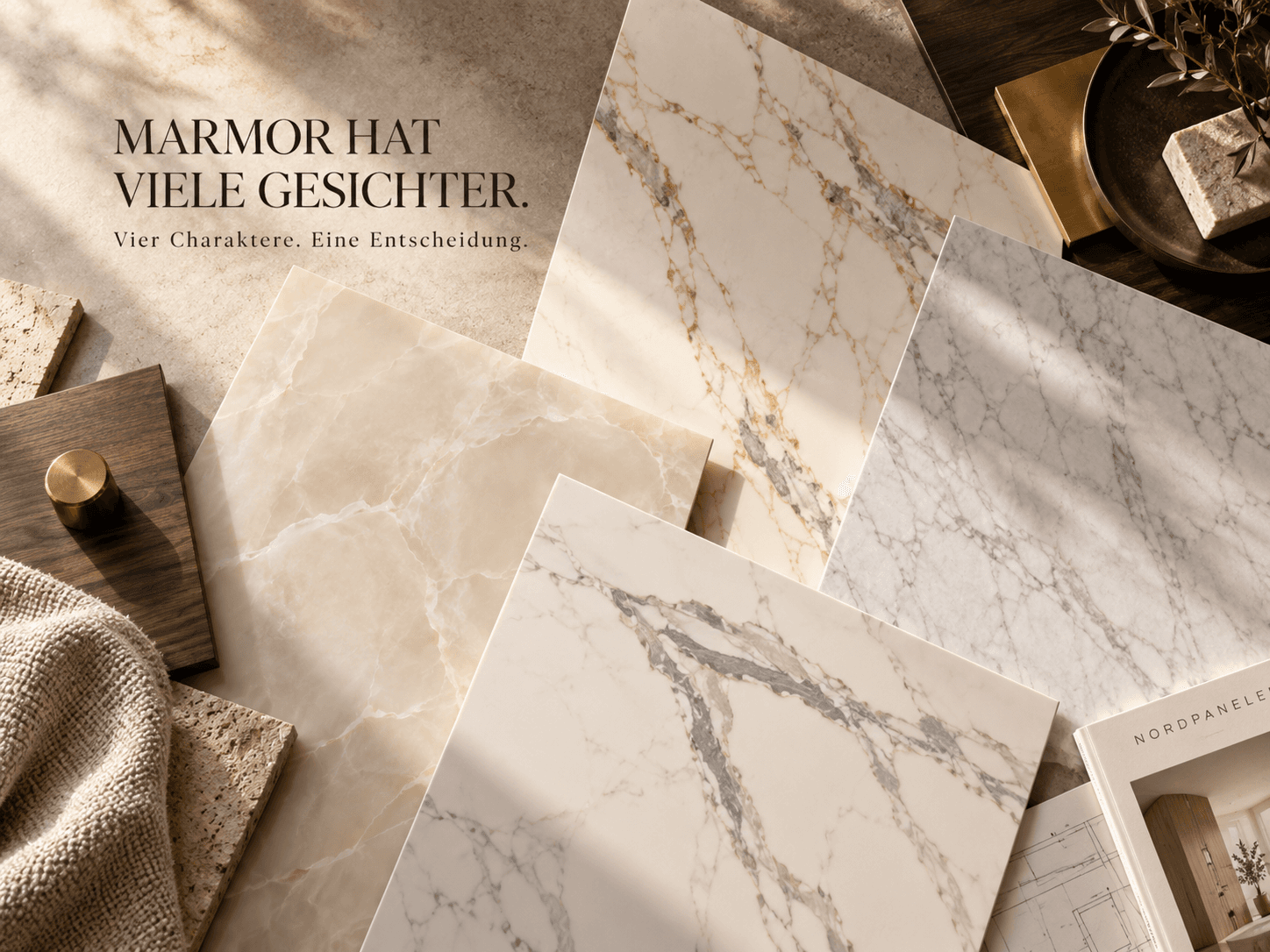
Marble Look: Which Decor Is Right for You?
Onyx Beige, Calacatta Gold, Statuario or Carrara — four marble characters, one decision. This guide helps you find the decor that suits your room and your style.
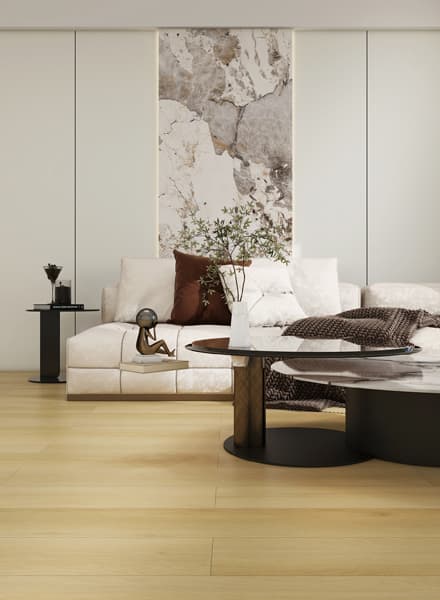
Warm Minimalism: The 5 Color Palettes for 2026
The clinical-white era is over: 2026 is dominated by Warm Minimalism with organic textures, terracotta, taupe, and soft marbles. Five palettes with matching panels.
12 Ideas for Wall Panels in the Living Room
From classic marble elegance to concrete industrial: 12 concrete design ideas for your living room accent wall, sorted by style.