April 17, 2026
12 Ideas for Wall Panels in the Living Room
A single accent wall can completely transform a living room. No paintwork, no demolition, no dusty week — an SPC panel wall is done in under three hours and lasts 20 years. Here are 12 ideas, sorted by style.
Classic elegance
Idea 1: Marble accent wall behind the sofa
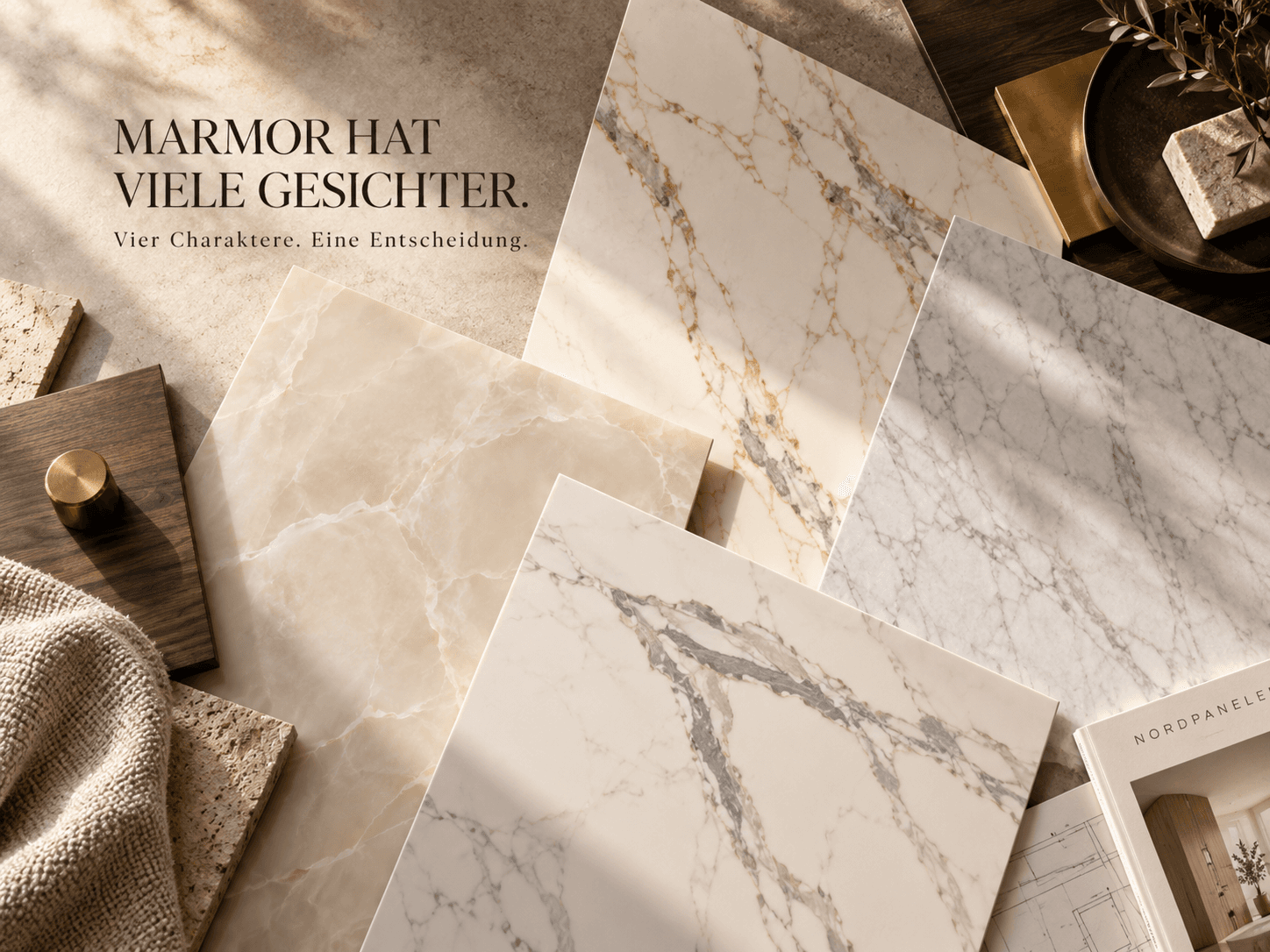
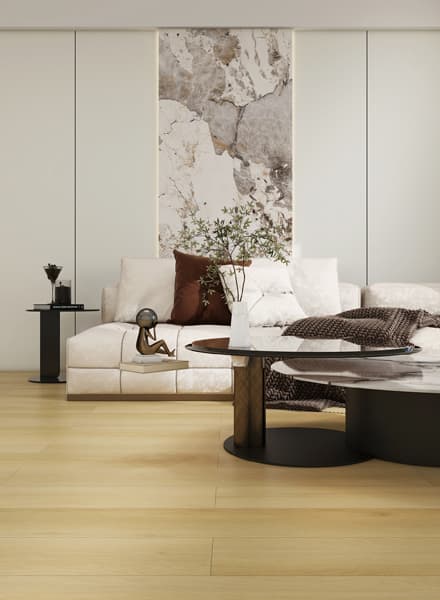
The safest, most timeless choice. A wall in Carrara or Statuario marble behind the sofa acts like a photographic backdrop. Pairs excellently with velvet upholstery in muted tones and warm, indirect lighting.
Idea 2: High-gloss marble as mini accent in the entryway
Not the whole wall — just 1.5–2 m² between door and coat rack. Acts as a statement foyer for visitors. High-gloss marble reflects light and brightens what's often a dim entry area.
Modern industrial
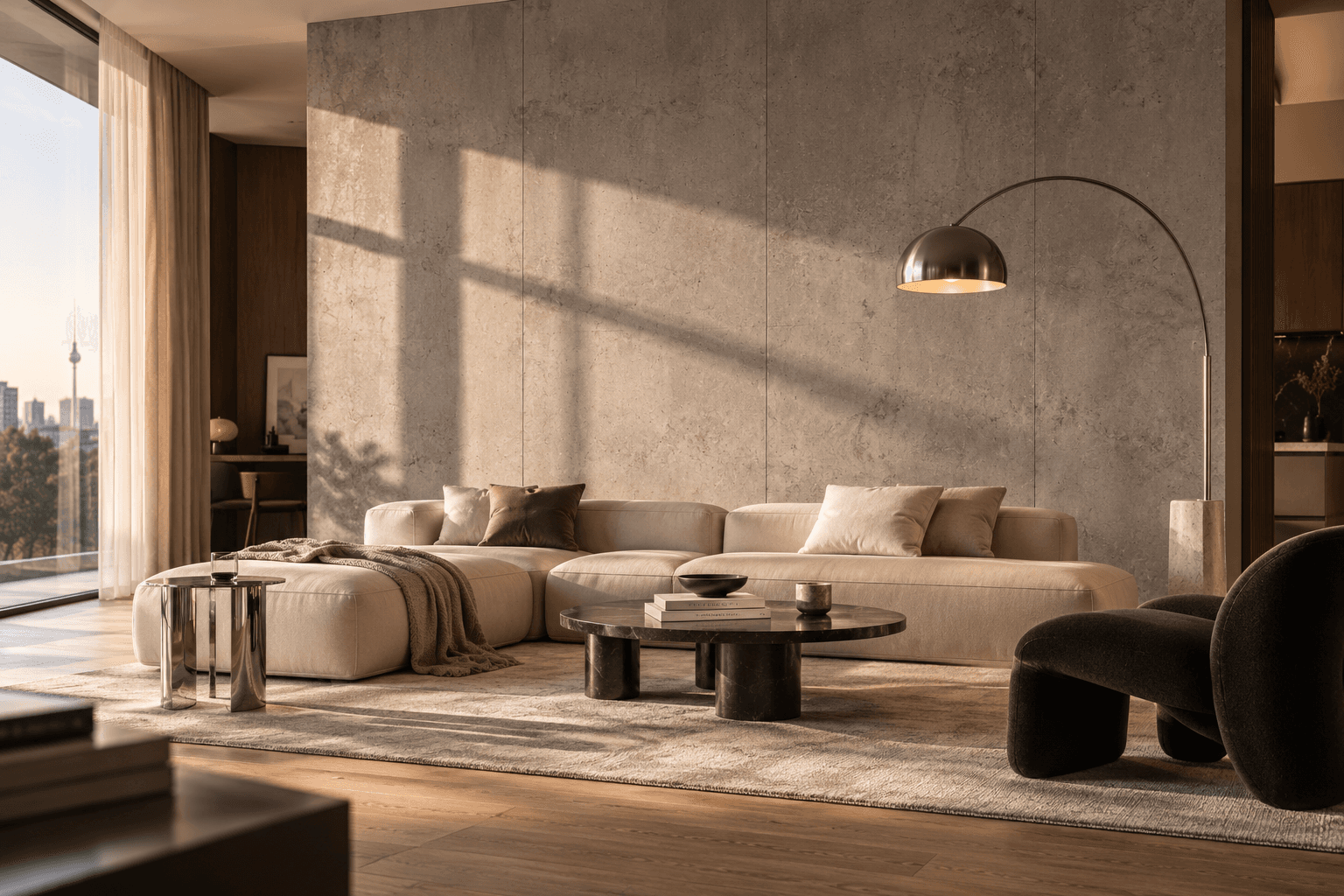
Idea 3: Dark concrete panel as TV wall
Anthracite concrete behind the flat-screen TV solves the "black-screen problem": the dark TV visually disappears into the wall. Combine with an understated sideboard in oak or walnut.
Idea 4: Half-height concrete, white above
Concrete panels to 110–120 cm height, painted white wall above. Transition accented with a narrow wooden shelf or horizontal LED strip. Industrial meets Scandinavian lightness.
Idea 5: Concrete niche around the fireplace
Old ethanol or gas fireplace in a niche? Concrete panels in the niche create a focal point. Maintain 30 cm safety clearance from open flame.
Organic and warm
Idea 6: Travertino Naturale as "clay house effect"
Travertino Naturale in warm earth tones acts like grown clay plaster, without the unevenness. Works particularly well in Mediterranean or Japandi-inspired interiors.
Idea 7: Two-tone wall in travertine and Chiaro concrete
Horizontal division of the wall in two panel tones. Lighter Chiaro concrete above, warm travertine below, separated by a narrow wooden strip. Visually deeper than single-colour walls.
Idea 8: Accent wall with climbing-plant frame
Light marble or travertine panel wall with vertical greening in front. The organic green against the mineral panel is an effect increasingly appearing in architecture magazines.
Playful and unexpected
Idea 9: Bookshelf backdrop
Line the wall behind an open bookshelf with dark marble or slate panel. Books suddenly "float" before a high-quality backdrop.
Idea 10: Home-office niche in the living room
A panel accent behind the desk looks more professional in Zoom/Teams calls than a bare wall. Chiaro concrete or light marble are optimal — they don't glare in screen reflections.
Idea 11: Indirectly-lit panel wall
LED strip at the top edge of the panel wall, with dimmable controller. In the evening the wall becomes an indirect light source.
Idea 12: Connect walls, don't separate them
In open living-dining areas: run panels around the corner — don't stop at one wall. The continuous panel section visually connects the two zones.
Which idea fits your room?
- Small living rooms (< 20 m²): light decors (Carrara, Chiaro concrete).
- Large rooms with lots of light: anything goes. Dark accents particularly dramatic.
- North-facing rooms with little daylight: high-gloss panels. They reflect available light multiply.
- Modern, light decor: concrete decors or marble.
- Classic, warm decor: travertino or warm marble variants.
Three common mistakes for living-room accent walls
Mistake 1: Picking the largest wall
Intuitively paneling the largest wall seems logical — but it often creates visual overload. Better: the wall with the clearest reference point (behind sofa, behind bed, behind TV) is the right one even if smaller. The accent wall must work, not be large.
Mistake 2: High-contrast panels in small rooms
Dark Beton Anthrazit looks dramatic in a 40 m² loft. In a 16 m² rental it overwhelms the room. Rule of thumb: rooms under 20 m² lighter decors (Carrara, Chiaro concrete, Travertino Beige). Dark accents only from 25 m² upwards.
Mistake 3: Panels fighting the interior
The new panel wall should complement, not overpower, the existing furnishings. Take a striking piece of furniture — the sofa, dining table, dresser — as colour reference and choose a panel in the same palette. Contrast only works when deliberately chosen.
How much panel for an accent wall?
Most living-room accent walls are 3–5 m². Example: a typical living-room wall of 4 m width and 2.5 m height (10 m²) doesn't need full paneling. Often a 3 m wide stripe on full height behind the sofa suffices — that's 7.5 m². With 10% waste margin: 8.25 m², rounded to 6 panels of 240 × 60 cm.
Tip: leave 10–15 cm "air" to the side walls on both left and right. A panel area running exactly to the side wall looks truncated. Panel area with visible white space beside it looks like a deliberate artwork.
Order up to 3 free samples. More ideas on our inspiration page.
Photographing your panel wall: the guide
A well-done panel wall is acquisition for your Instagram feed. Three concrete tips for photos that look expensive:
- Light from the side, not front-on. Side light brings out texture. Frontal flash flattens marble.
- Low perspective. Knee height rather than eye height. Looks more premium, like interior magazines.
- Let the space breathe. Don't overcrowd. One plant, one vase, one lamp — not more.
Related articles: Installing wall panels in 9 steps · SPC vs PVC vs real wood · Warm Minimalism 2026