April 20, 2026
EU Ecodesign 2026: What ESPR Means
On 18 July 2024 the European Union adopted the revised Ecodesign for Sustainable Products Regulation (ESPR). From 2026 the first concrete requirements apply to interior products, including wall claddings. For buyers, architects, and tradespeople this fundamentally changes what information must be available about a panel. For manufacturers, sustainability moves from a marketing talking point to a regulatory obligation. This article explains what ESPR concretely means for wall panels, what the Digital Product Passport contains, and how you as a buyer benefit.
What is ESPR?
ESPR is the successor to the Ecodesign Directive 2009/125/EC, which until now primarily regulated energy-related products (refrigerators, washing machines, lamps). With the new regulation, the EU dramatically widens its scope — to practically every physical good placed on the EU market.
The regulation sets product-specific requirements on:
- Durability
- Repairability
- Reusability
- Upgradability
- Recyclability
- Recycled content
- Energy and resource efficiency
- Carbon footprint
- Presence of substances of concern
The EU Commission is developing delegated acts for individual product groups, so-called Working Plans. Wall claddings are Priority 1 — part of the first wave becoming binding between 2026 and 2029.
Why wall panels were prioritised
The Commission ranks product groups by environmental impact and market volume. Wall claddings landed in the priority list for three reasons:
- High market volume. The European decorative wall-panel market is estimated at over €4 billion by 2031. Any efficiency improvement multiplies massively.
- Significant emission source. PVC production in particular is energy-intensive; halogen-free polymer alternatives exist but are rarely used under market pressure. ESPR forces transparency.
- Weak recycling rate. In Germany, used wall cladding ends up >85% in thermal recovery (incineration). That's waste — technically sorted recycling of SPC and pure PVC panels is feasible.
The Digital Product Passport (DPP): the heart of ESPR
The most important operational building block is the Digital Product Passport. From 2026, all wall panels placed on the EU market must carry a DPP retrievable via QR code, NFC tag, or RFID chip. The passport contains structured, machine-readable data on:
1. Material composition
Complete declaration of all raw materials, mass shares, and origin regions. For an SPC panel: calcium carbonate share, PVC share, plasticiser type and quantity, stabilisers, wear layer (PU or alternative), every additive.
2. Recycled content
What percentage of the product comes from recycled or post-consumer material. ESPR targets for wall panels are phased in — from 2027 a minimum recycled content of 10% is expected, by 2030 a share of 25%.
3. Carbon footprint (PCF)
Calculated CO₂ footprint per DIN EN 15804 or ISO 14040 ff, depending on the forthcoming Technical Act. Measured cradle-to-gate. Calculation must be verified by independent bodies; self-declarations no longer suffice.
4. Lifespan and durability evidence
Tested useful life under standard conditions, usually 20 or 25 years for quality wall claddings. Tests cover abrasion resistance (EN 15186), colour fastness (EN ISO 105-B02), cyclical moisture exposure behaviour, and UV exposure.
5. Repair information
Can individual panels be replaced if damaged? Are spare parts available? Disassembly documentation? For SPC with click-system, an easy exercise — for glued PVC panels a systemic problem.
6. Disposal instructions
At end of life: how is the material properly disposed of? Who takes it back? Which recycling stream? ESPR obliges manufacturers to build functioning take-back systems.
7. Presence of substances of concern
Evidence per REACH regulation and SVHC Candidate List. Currently relevant: phthalate plasticisers, certain lead stabilisers (no longer used in modern panels, but documentation obligation remains). SPC panels are typically phthalate-free because their stiffness comes from mineral content.
Technical implementation of the DPP
The product passport is technically held as structured data (JSON or XML), retrievable via three identification channels:
- QR code on panel, packaging, or datasheet
- NFC tag for smartphone access without camera
- RFID chip for industrial logistics and automatic recycling sorting
The EU Commission is developing the "European Digital Product Passport System" (EDPPS) as central data infrastructure. Every DPP will be identifiable via a unique EU-wide product ID. Access is three-tiered: publicly open (sustainability data), authorised (tradespeople, disposers), and proprietary (manufacturer-internal).
SPC vs WPC vs PVC: ESPR readiness compared
ESPR impacts the three common panel categories differently:
SPC (Stone Plastic Composite) — high ESPR readiness
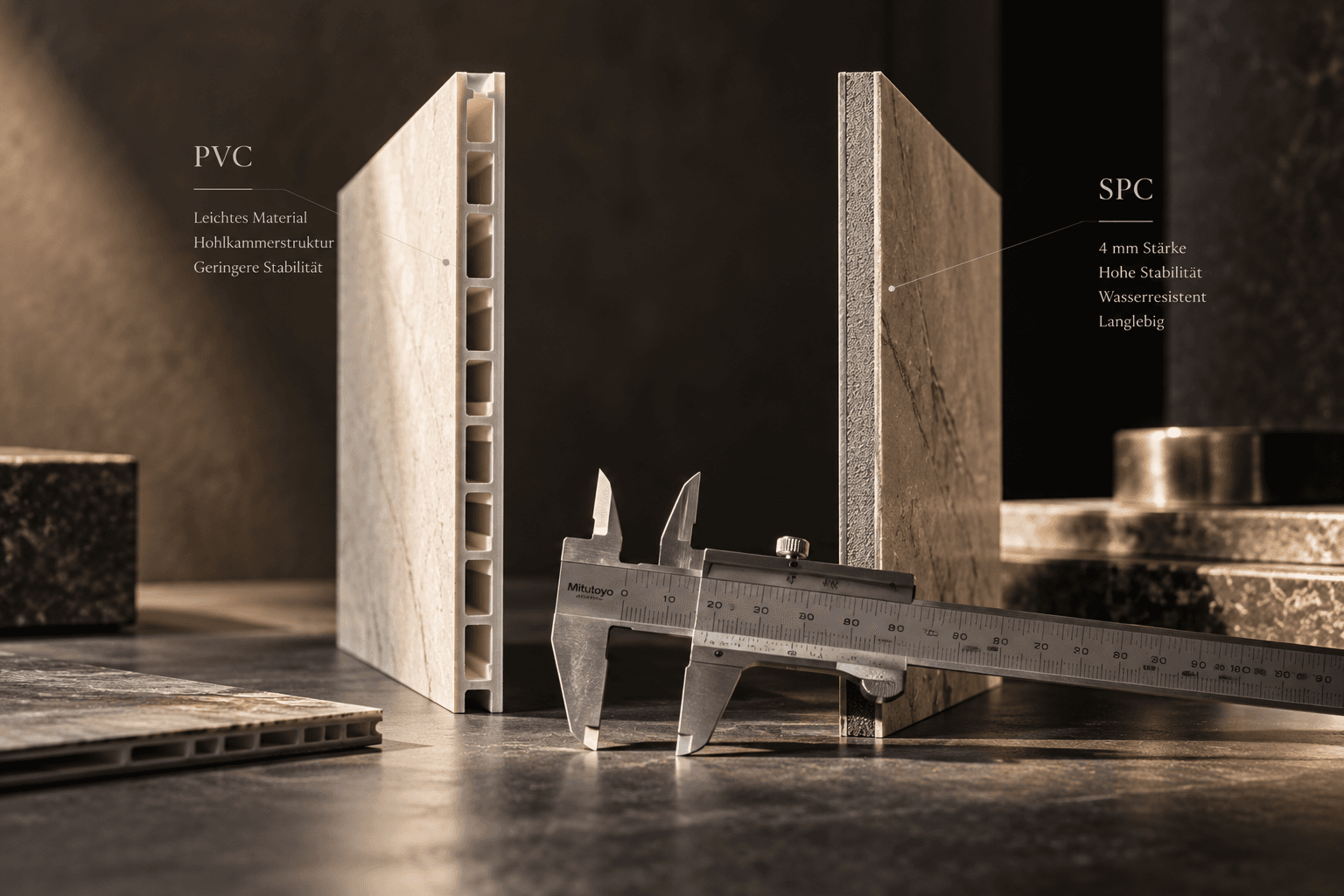
The 65–70% mineral core content reduces plastic consumption drastically. Click-system installation enables tool-free disassembly and therefore sorted recycling. CO₂ footprint per m² typically sits at 4–6 kg CO₂≅ — compared to 8–12 kg for pure PVC panels. 20+ year lifespan well documented. Conclusion: SPC meets ESPR requirements largely without major re-engineering investments.
WPC (Wood Plastic Composite) — medium ESPR readiness
Wood content reduces plastic consumption but is challenging for recycling: the mix of wood fibres and thermoplastic polymer is mechanically hard to separate. Thermal recovery often remains the only option — not ESPR-compliant in priority ranking.
Pure PVC — low ESPR readiness
High plastic content, often still with phthalate plasticisers. Glued installation instead of click-system makes disassembly and reuse difficult. CO₂ footprint significantly higher. Pure PVC panels are likely to receive the worst ESPR rating and may exit the EU market by 2030 unless manufacturers reformulate.
Phased rollout: what comes when
- 2024–2025 — ESPR adopted, Working Plan created, precursor standards in drafting.
- 2026 — First delegated acts for wall claddings. DPP pilot phase. Public procurement (federal, state, municipal) already requires DPP-compliant products.
- 2027–2028 — Mandatory DPP registration for all wall panels placed on the EU market. Minimum recycled content (around 10%) applies.
- 2029–2030 — Stricter CO₂ limits. Recycled content up to 25%. Products that don't meet thresholds are removed from the market.
What changes for you as a buyer
- Transparency becomes the norm from 2026. Scan the QR code on the packaging and directly see what the panel is made of, its recycled-content share, disposal requirements, and tested lifespan. No more "manufacturer says" rumours.
- Product selection for public procurement narrows. From 2026, schools, authorities, and municipalities can't procure panels that aren't DPP-compliant. This pulls the entire supplier landscape towards compliance.
- Insurers start differentiating. Buildings built with fully documented, durable, repairable materials get better terms. DPP documentation becomes a standard element of building insurance.
- Resale value of your property rises. A complete DPP record of all interior materials increases market value on resale — analogous to the energy certificate, only more detailed.
- Budget suppliers will disappear. Under ESPR compliance costs, only manufacturers that commit to durability and transparency survive long term. Bargain panels from undocumented sources vanish.
What changes for B2B buyers
Architects and interior designers will be required to integrate DPP data into tender documents for public contracts. Not yet mandatory for private projects but increasingly standard. General contractors will rate their suppliers strictly on ESPR compliance — those who don't move fall off whitelists.
Drywall and interior trades will need to ask new questions at purchase: DPP available? Recycled content? Take-back system established? Those who can't answer lose the contract.
NordPaneele and ESPR
We started in 2025 converting our entire SPC wall panel collection to full ESPR compliance. The first Digital Product Passport pilot starts summer 2026 — initially for the Carrara Bianco and Beton Anthrazit ranges, then for all other products.
Our current metrics (already available on request):
- Mineral core share: 68–70% (calcium carbonate)
- Recycled content PVC: currently 12%, target 25% by 2028
- Phthalate-free: yes, documented per REACH
- CO₂ footprint: 4.8 kg CO₂≅ per m² (cradle-to-gate, verified 2025)
- Tested lifespan: >25 years under standard use
- Repairability: individual panels replaceable via click-system
- Recycling partners: partnership with two certified plastics recyclers in Germany
ESPR frequently asked questions
When as a buyer do I need to watch for the DPP?
For private buyers, the DPP effectively starts at the latest by 2027 — the first wall panels with mandatory DPP will enter the market then. For public tenders and larger commercial projects, the DPP is already relevant from 2026 because public procurement guidelines have leader effects. Anyone buying in 2026 planning to use the panels 10+ years should consider ESPR readiness as a purchase criterion already.
What happens to my already-installed panels?
Nothing. ESPR applies exclusively to products placed on the EU market after the cutoff date. Existing installations remain legally untouched. A grandfathering clause is explicitly included in the regulation text to avoid retrospective liability questions.
Will ESPR raise prices?
Yes, but moderately. Industry estimates sit at 3–8% price markup for fully ESPR-compliant wall panels — significantly lower than the initially feared 15–20%. Reason: most compliance costs (certification, DPP generation) are amortised across large production volumes. Manufacturers already producing high quality (ISO-certified plants, documented supply chains) have lower incremental compliance costs than budget suppliers.
Does ESPR also apply to imports from Asia or outside the EU?
Yes. The regulation applies to all products placed on the EU market — regardless of production location. That means: Asian manufacturers still wanting to export to the EU must name an EU-based responsible person ("Fulfilment Service Provider" or importer) fulfilling the DPP obligation. For pure grey-market imports via postal shipping from China, that's practically an exclusion — good for serious European suppliers.
What's the difference to existing sustainability certifications like Blue Angel?
Blue Angel and similar labels are voluntary seals with their own criteria. ESPR is a mandatory legal requirement with unified EU criteria. The two don't exclude each other: a Blue-Angel-certified panel likely meets ESPR requirements by a clear margin. But an only-ESPR-compliant panel isn't automatically Blue-Angel-certified.
What NordPaneele concretely does
Our ESPR implementation runs in three phases:
- Phase 1 (completed, 2024–2025): full documentation of all materials, suppliers, and supply chains; CO₂ accounting per DIN EN 15804 by external verifier; selection of recycling partners.
- Phase 2 (in progress, 2026): pilot DPP for two flagship products (Carrara Bianco Glossy, Beton Anthrazit); QR code on packaging; public accessibility of data.
- Phase 3 (2027–2028): DPP for the entire collection; recycled content raised to 15% (currently 12%); take-back system for used panels in cooperation with two certified recyclers.
Those who'd already like to buy ESPR-compliant today: we send our sustainability data (material breakdown, CO₂ balance, recycled content) as PDF on request. Contact: kontakt@nordpaneele.de or via our sustainability page.
Summary
- ESPR is EU law since July 2024 and applies to wall panels from 2026 with gradually stricter requirements through 2030.
- The Digital Product Passport is the central instrument — retrievable via QR code, with structured data on material, recycled content, CO₂, lifespan, repair, and disposal.
- SPC panels are structurally well positioned because their high mineral content, click installation, and documented durability already largely satisfy ESPR criteria.
- Pure PVC panels will struggle to meet coming recycled-content and CO₂ thresholds without complete reformulation.
- Buyers benefit from more transparency, better insurance terms, and higher resale values of documented-sustainable interior materials.
Three misconceptions about ESPR
"This is only for large companies." False. ESPR applies to every business placing products on the EU market. Small manufacturers and resellers are equally affected. The difference lies only in which support options (funding programmes, trade association help) are available.
"ESPR just means more bureaucracy." Partially true, but incomplete. Yes, documentation requirements rise. But at the same time ESPR replaces several fragmented national regulations with a single EU standard — reducing bureaucracy for manufacturers shipping EU-wide.
"I can wait until 2030." Strategically dangerous. Anyone still developing wall panels today without ESPR planning will realise by 2028 at latest that the product is no longer marketable. Certification lead time (testing, DPP build, supplier re-certification) is realistically 18–24 months. Start in 2026, you're ready by 2028. Start in 2028, you're in trouble by 2030.
Questions about our ESPR readiness? We share our current sustainability metrics on request. Contact via kontakt@nordpaneele.de or our sustainability page.
Three typical customer conversations about ESPR
"Do I need a QR code on the packaging?" Yes, but not immediately. For wall panels this becomes mandatory from 2027. The QR code links to the Digital Product Passport URL operated by the EU EDPPS system.
"Can I fill in ESPR data myself or do I need a service provider?" Technically, manufacturers can manage the data themselves, but verification (especially the CO₂ footprint) must be confirmed by an accredited body. The path here goes via specialist consultancies or DIN-certified testing labs.
"What happens if a manufacturer doesn't comply with ESPR?" Fines vary by EU country but typically range from 5–10% of group annual turnover. Larger still is the loss of distribution rights in the EU market — which can end a product entirely.
Related articles: SPC vs PVC vs real wood · Fire safety classes B1 explained