

April 17, 2026
SPC vs PVC vs Real Wood – Wall Panels Compared
If you're considering wall panels, within 20 minutes of research you encounter three materials: SPC, PVC, and real wood. Marketing tells you each is "the best material." The truth is more nuanced — and depends on what you want to do with the wall.
Quick overview: Which material for which purpose?
- Bathroom, kitchen, basement, sauna → SPC. The only material that durably withstands real water.
- Living room, bedroom, hallway (pure dry areas, small budget) → PVC or MDF may be sufficient.
- Living room, bedroom, hallway (premium expectations, no moisture) → Real wood for authentic haptics, SPC for ease of maintenance.
- Commercial spaces with fire-safety requirements → SPC (class B1 inherently) or specially fire-retardant real wood.
1. SPC (Stone Polymer Composite)
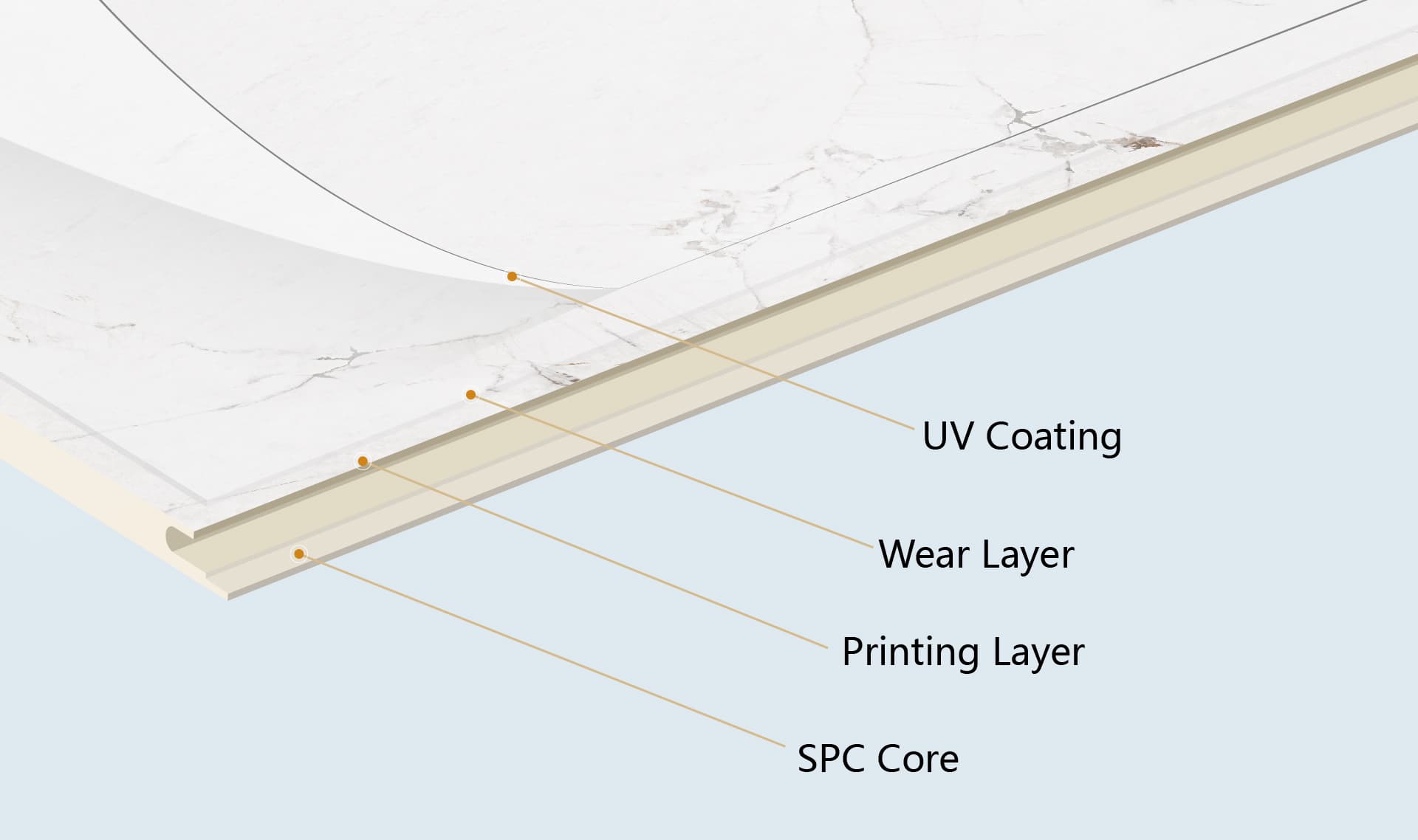
SPC panels consist of around 60-70% ground limestone combined with a thermoplastic polymer. The result is a mineral composite material harder than PVC, more dimensionally stable than MDF, and 100% waterproof.
Waterproofness is the decisive factor. Unlike PVC (which can swell with faulty click connections) or MDF (irreparably destroyed by moisture), SPC absorbs no moisture — not even with prolonged water contact.
Dimensional stability is the second key point. Under temperature fluctuations (summer: 30 °C wall temperature, winter: 18 °C), SPC expands only ~0.1 mm per meter. PVC expands five times as much.
Fire safety class B1 is built in as standard. The high limestone content makes SPC inherently low-flammability.
How SPC is manufactured
Understanding the manufacturing process helps evaluate quality differences between suppliers. SPC is produced via extrusion: a mixture of limestone powder (65–70%), PVC granulate (20–25%), stabilisers, and pigments is formed at 170–190 °C in a screw extruder into a continuous strand. After cooling, the core plate is cut to size, a decorative print layer (usually PET film in digital print) and a PU protective layer are applied. Finally the click profile is milled into the edges.
Quality differences arise primarily at three points: the uniformity of core density (cheap production creates air inclusions that can later lead to breakage), print-layer quality (16-bit digital print looks significantly more realistic than 8-bit offset), and PU wear-layer thickness (from 0.3 mm SPC is residential-suitable, from 0.5 mm approved for high-use areas like hallways).
Density and longevity
The key metric for durability is core density in g/cm³. Premium SPC panels reach 1.9–2.1 g/cm³ — denser than many natural stones and significantly denser than WPC (Wood Plastic Composite, typically 1.1–1.3 g/cm³). High density means less air in the material, fewer failure points, higher compressive and impact strength. In lab testing a 4 mm SPC panel withstands point loads up to 450 N before permanent deformation — a comparable PVC panel fails at around 180 N.
The real downsides of SPC
Price is higher than cheap PVC panels. A 4 mm SPC plate costs €40–70 per m²; comparable PVC is available from €15–25 per m². For large surfaces in dry areas PVC may be the more economical choice.
Weight is a minor drawback: SPC weighs ~9 kg per m², PVC 4–5 kg. That matters at delivery and when carrying — a 240×60 cm SPC plate weighs around 13 kg. No problem for an adult tradesperson, but when transporting to the ceiling plan for a second person.
Recycling infrastructure in Germany is still being built. While SPC is technically sorted recyclable, flanked collection systems only roll out from 2027 under the ESPR regulation. Until then disposal usually occurs via thermal recovery.
2. PVC (Polyvinyl chloride)
PVC panels have been around since the 1970s. They're lightweight, cheap, available in countless decors, and entirely adequate for basic use cases.
The real downsides of PVC
Plasticisers: many cheap PVC panels contain phthalates — plasticisers classified as reproductively toxic and endocrine-disruptive. Premium European manufacturers today use phthalate-free plasticisers, but for imported panels from unknown sources this is by no means guaranteed.
Temperature sensitivity: under direct sunlight or above radiators PVC panels expand significantly more than SPC. With improper installation panels can dislodge from their click connection after a summer.
Limited durability: PVC ages. Plasticisers off-gas, UV light bleaches the decor, after 5–10 years panels look noticeably tired. SPC panels last 20+ years with good care.
Phthalates: what you should know
Phthalates are the most common plasticisers in conventional PVC. The EU has classified four phthalates (DEHP, DBP, BBP, DIBP) as reproductively toxic and added them to REACH Annex XIV — their use in new products has been restricted since 2015 and requires special authorisation. Premium European PVC panels therefore now use DINP- or DINCH-based alternatives, which are significantly less critical. For imported panels from Asia without CE marking or full declaration of performance, you should stay skeptical.
Ask specifically for the current declaration of performance (DoP) and REACH status. Serious manufacturers provide both within 48 hours by email.
When PVC makes sense anyway
We don't sell PVC — so full disclosure: when we recommend PVC, we mean it honestly. Pure PVC is the right choice for: very limited budget (rental apartment, temporary solution), areas without moisture or temperature fluctuations (ceilings, niches), and large-area projects with short usage duration (exhibitions, pop-ups). For permanent residential installation SPC is the sounder investment.
3. Real wood (solid or veneer)
Real wood panels are the oldest and most prestigious variant. Either fully solid (e.g. oak, walnut) or as veneer on a stabilising carrier plate. The haptics are incomparable.
The real advantages
Authenticity is the point. No photorealistic print, however good, can fully reproduce grain, smell, and patina of real wood.
Sustainability (with correct origin): FSC-certified wood from sustainable forestry is the ecologically cleanest material of the three.
The real disadvantages
Price: quality real-wood panels cost €80–180 per m². Plus installation (€40–80 per m² by a specialist). A 10 m² accent wall quickly hits €1,800–2,600.
Moisture sensitivity: unsuitable in bathrooms — period. Maintenance: occasional oiling or lacquering. Scratch sensitivity: pets, children, furniture moves leave traces.
Which wood for which effect?
If you decide on real wood, the wood species matters almost more than the processing technique. Brief overview:
- Oak — the classic. Medium hardness (Brinell 34), clear grain, takes stain and oil equally well. Fits almost any style, from rustic to modern.
- Walnut — deeper, warmer colour, finer grain. Elegant but pricier than oak.
- Larch — lighter colour with pronounced knot patterns. Harder than oak, but resinous.
- Smoked oak — oak darkened via ammonia treatment. Highly on-trend (2025/2026).
- Acacia / robinia — native alternative to teak. Very hard, very durable.
Solid or veneer?
For decorative wall panels veneer is usually the better choice. A veneer panel consists of a 0.6–3 mm thin real-wood layer on a stable carrier (MDF or HDF). Three advantages over solid: dimensional stability (no wood movement under climate swings), price (50–70% cheaper), environmental footprint (one cubic meter of trunk yields up to 20 times more veneer panels than solid-wood panels).
Direct comparison: numbers for a 10 m² accent wall
- PVC (mid-range): €200–350 material, 2–3 hours self-installation, ca. 5–8 years lifespan.
- SPC (NordPaneele quality): €450–700 material, 2–3 hours self-installation, 20+ years lifespan.
- Real wood (e.g. oak): €800–1,800 material + €400–800 installation, lifetime with care.
Over a long time horizon (10+ years) SPC is clearly the most economical choice.
Frequently asked questions
Can I install SPC without a substructure?
Yes, and that's one of the biggest benefits. With click-system, SPC panels are glued directly to the wall or floated over a thin mounting profile (1–3 mm). No elaborate battening needed — saving 3–4 cm of room depth on a 10 m² wall.
What happens to SPC under strong sunlight?
Quality SPC is UV-stable and tolerates direct sun without fading. The mineral content also ensures low thermal expansion — even behind large south-facing windows the click joint stays tight. With budget PVC it's different: up to 5 mm length expansion per meter over summer is common.
Mould behind SPC panels — is that a concern?
Only with faulty installation. Since SPC is completely diffusion-tight, moisture behind the panel can't dry out. Important: dry, primed wall before installation; no installation on freshly plastered or tiled walls (min. 28 days drying); on exterior walls in older buildings, check for vapour barrier. With code-compliant installation mould is not an issue.
Can SPC be painted or repainted?
Technically possible, practically not sensible. The PU wear layer is optimised for abrasion resistance — paint adheres poorly and peels. If you want to change the look, swap individual panels via click-system instead.
What fire class does PVC have by comparison?
Standard B2 (normal flammability) — without flame-retardant additives. With additives B1 is achievable, but watch out: some flame retardants are themselves REACH-relevant (SVHC). SPC reaches B-s1,d0 per EN 13501-1 naturally because 65–70% calcium carbonate isn't combustible. More in our article Fire safety classes explained.
Is SPC suitable for underfloor heating?
Yes — though we're talking wall panels here. The same technology (SPC core) is available as vinyl flooring, approved for water underfloor heating from 28 °C surface temperature. Same rule for wall installation over a baseboard heater or IR panel: surface temperature below 28 °C.
How ecological is SPC really?
Honest answer: SPC is not a 100% natural product. CO₂ footprint lies at 4–6 kg CO₂ equivalent per m² (cradle-to-gate) — better than porcelain tiles (15–22 kg) or natural stone (8–20 kg), but worse than untreated FSC wood (2–3 kg, if sourced locally). The ecological balance improves via longevity: a 20-year SPC panel often has a better per-usage-year footprint than a PVC panel replaced every 5–7 years.
Pre-purchase checklist
What to ask your supplier before ordering:
- Material composition — for SPC: how high is the mineral content? Below 60% it's not real SPC anymore, but PVC with filler.
- Core density — target ≥ 1.9 g/cm³.
- Wear-layer thickness — 0.3 mm minimum for residential, 0.5 mm for high-traffic areas.
- CE marking + Declaration of Performance (DoP) — both required in the EU. If either is missing, the supplier has a compliance problem.
- Fire safety certificate — full EN 13501-1 classification (not just "B1"), testing institute with DAkkS accreditation.
- REACH compliance — phthalate-free for PVC-based products.
- Return rights — minimum 14 days per distance-selling law; better suppliers offer 30 days.
Our recommendation
If you're torn between SPC and real wood: both are good choices. Ask yourself whether authenticity or ease of maintenance matters more. For bathroom, kitchen, or basement the answer is always SPC — no exceptions.
Against cheap PVC we advise against for permanent residential installation in general. The 50–70% price advantage disappears within the first 8 years through replacement necessity, and the contaminant history of conventional PVC is reason enough to switch to the more modern-formulated SPC.
Want to feel SPC for yourself? We'll happily send you up to 3 free samples — including a click connection. Our SPC info page goes deeper into technical specifications.
The most important certificates compared
When comparing SPC, PVC, and real wood, you should know the following certificates and standards because they form your legal shield for warranty and building acceptance:
- CE marking (Construction Products Regulation EU 305/2011): mandatory for all wall claddings in the EU. Without CE, the product can't even be sold.
- EN 13501-1: fire behaviour per Euroclass (A1 to F plus s/d values). More informative than the national DIN 4102-1.
- EN 16516: VOC emissions in interior spaces. Particularly relevant for children's and bedrooms.
- REACH regulation (EC 1907/2006): SVHC substances, phthalates, heavy metals. Applies from raw material to finished product.
- PEFC or FSC: sustainable forestry for real wood or wood-containing components.
- Blue Angel (DE-UZ 176): voluntary German eco-label for low-emission construction products. Nice-to-have, not mandatory.
For all our SPC panels we provide CE, EN 13501-1 certificate, EN 16516 emissions report, and REACH declaration of conformity on request — within the same working day via email. If your chosen supplier takes longer than 48 hours, you have a warning signal.
Total cost of ownership over 10 years
An often-overlooked perspective is total cost of ownership (TCO). Example for a 10 m² wall: PVC panels last on average 6 years under intensive use; over 10 years that means 1.67 replacement cycles. Total TCO: roughly €600–800. SPC panels last 20+ years, a one-time investment of €500–700 suffices. Real wood panels last just as long but with occasional re-lacquering (every 5 years, €150 per pass) you reach around €1,500 TCO. SPC clearly wins the TCO view.
Related articles: Installing wall panels: complete 9-step guide · Wall panels in the bathroom: 7 things before purchase · Fire safety classes B1 explained
More articles
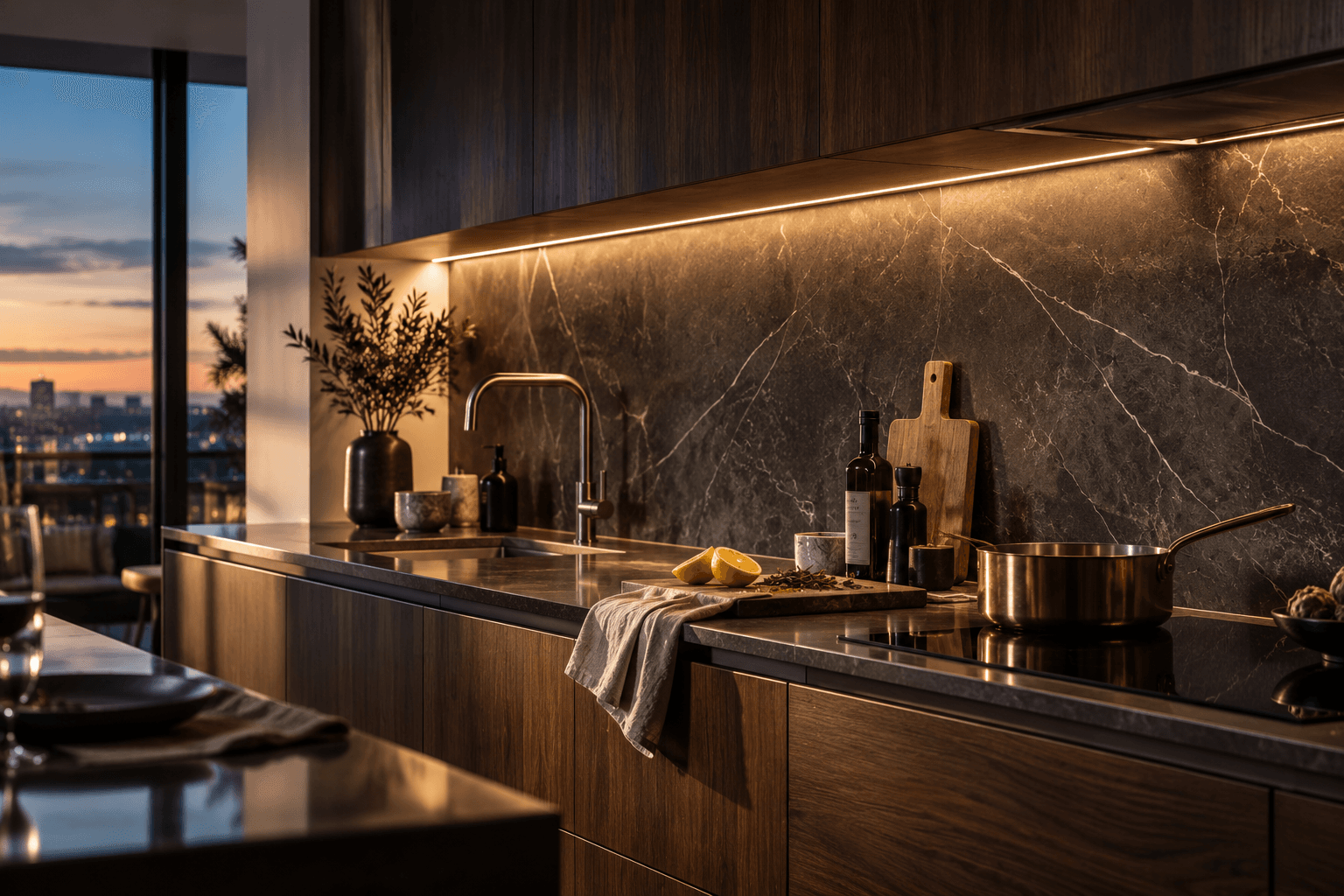
SPC Kitchen Backsplash: Pros and Cons
SPC wall panels in the kitchen: an honest assessment. What they do better than tiles, where the limits are, and how to handle the hob heat question.
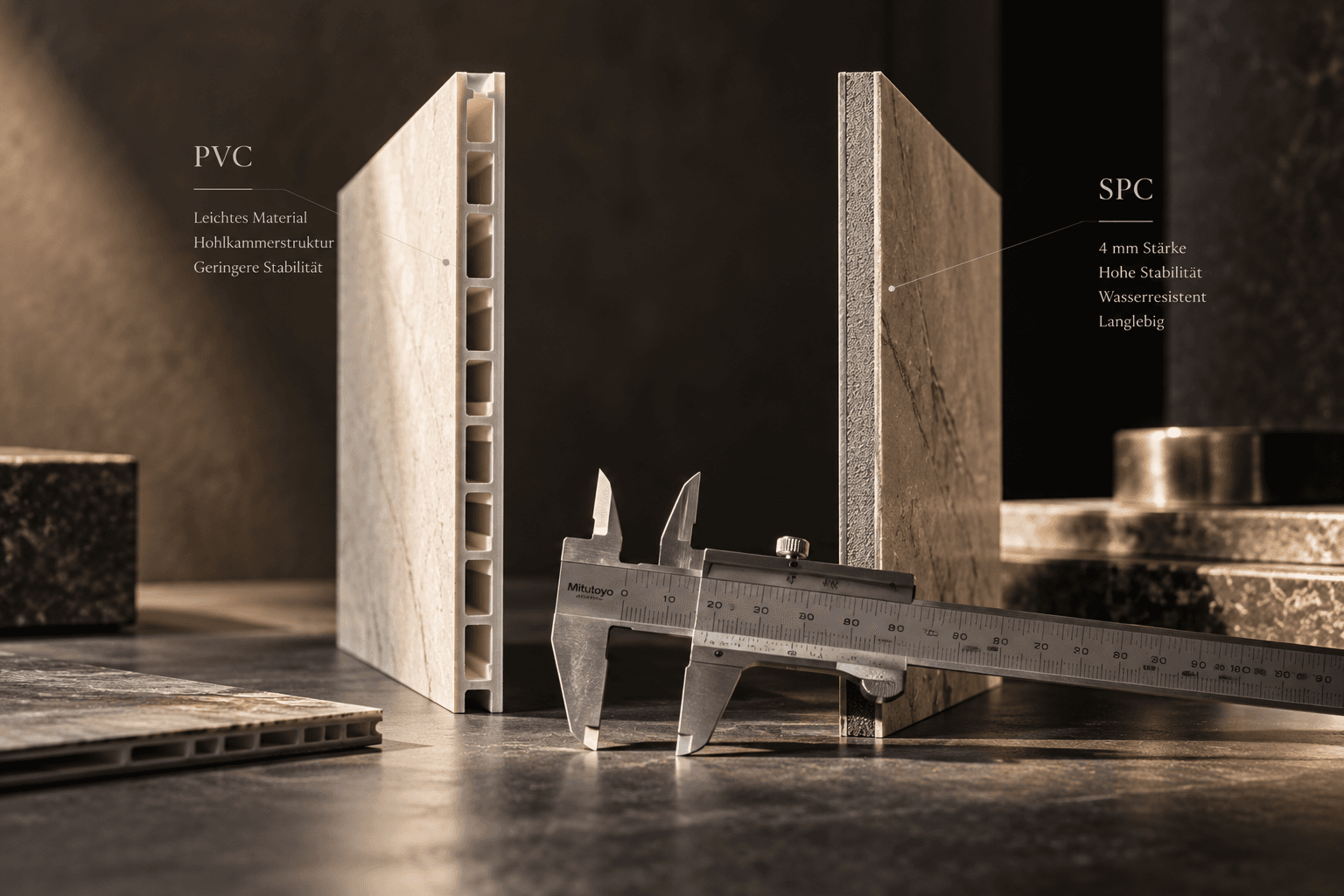
SPC vs PVC Panels: The Full Comparison
Same decor, different core: what really separates SPC and PVC wall panels — core structure, waterproofness, stability and lifespan compared head to head.
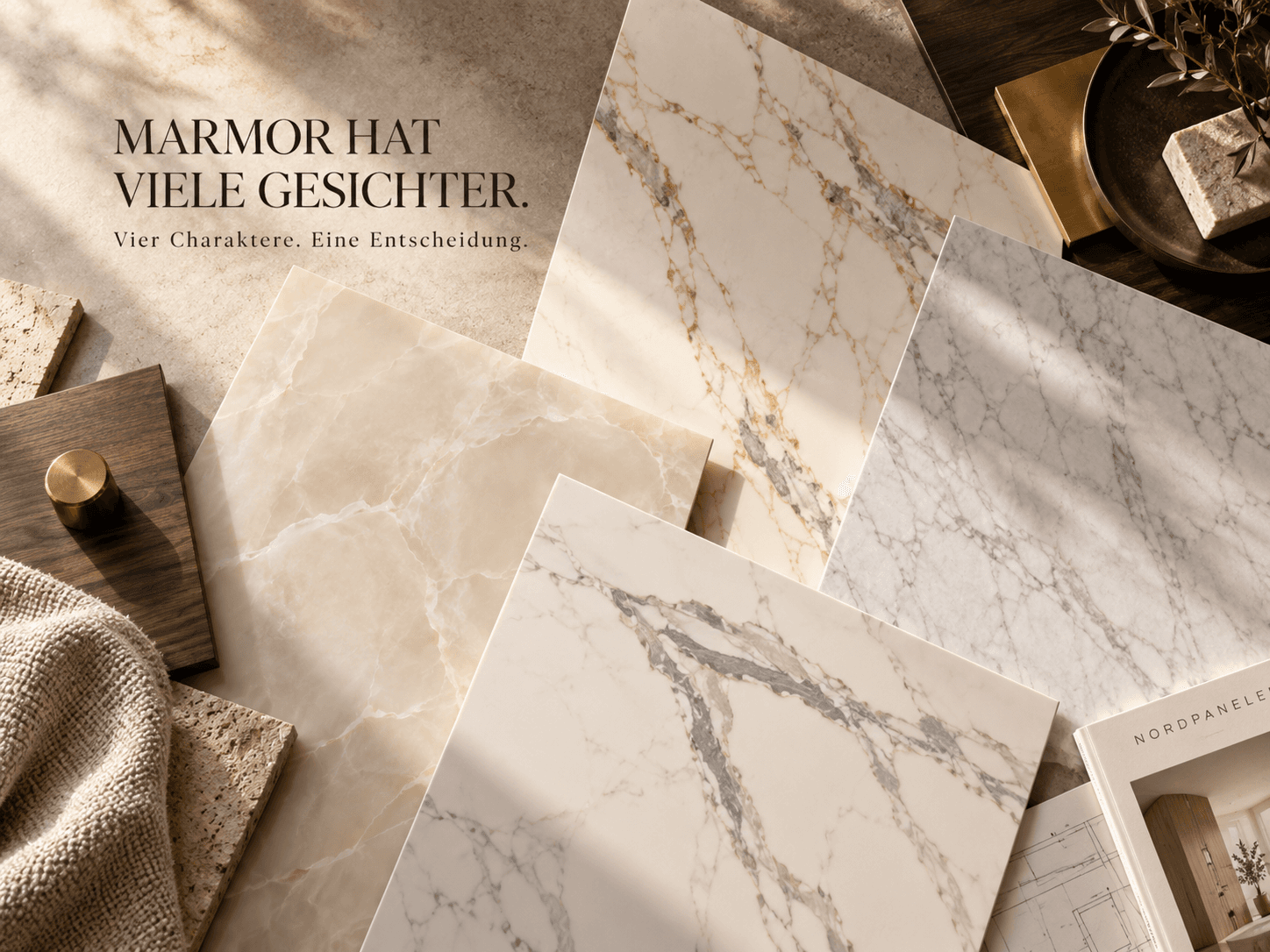
Marble Look: Which Decor Is Right for You?
Onyx Beige, Calacatta Gold, Statuario or Carrara — four marble characters, one decision. This guide helps you find the decor that suits your room and your style.