Why Large Formats Are the New Language in Bathrooms
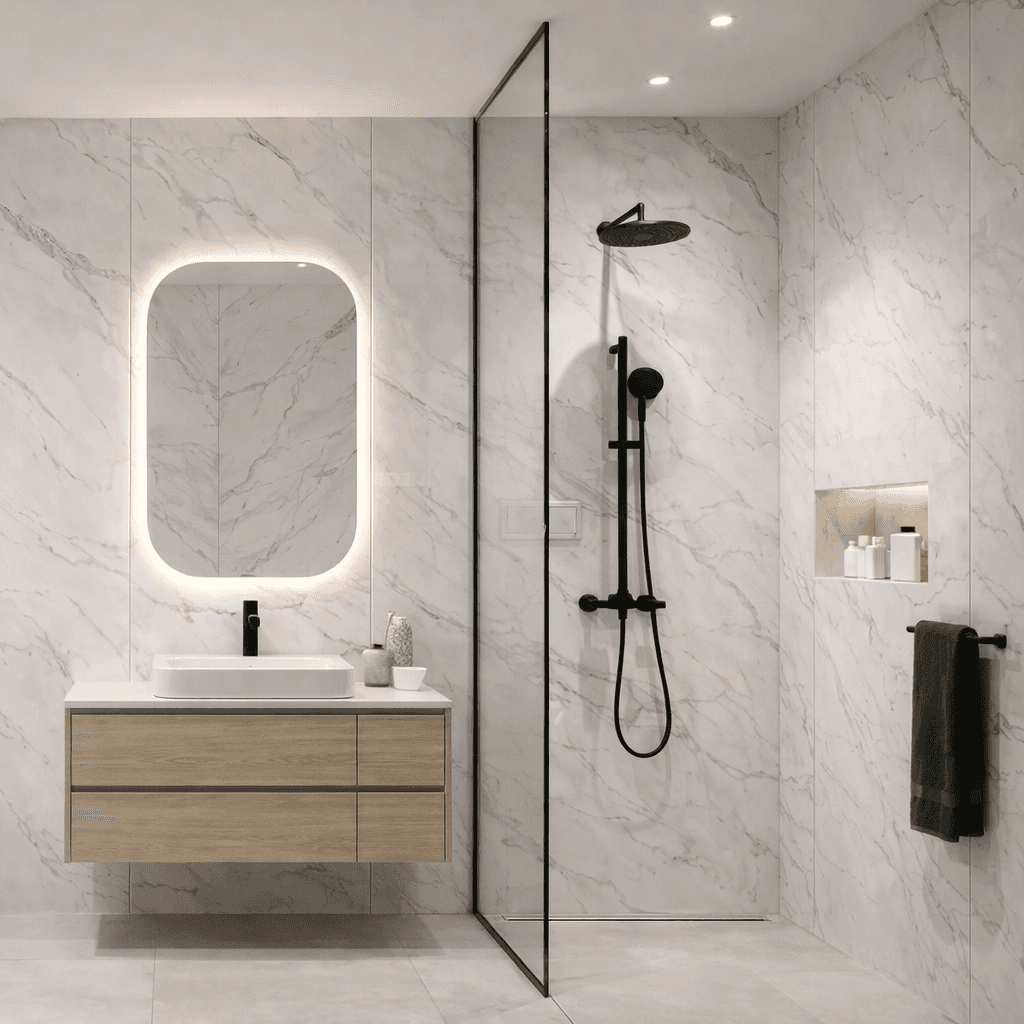
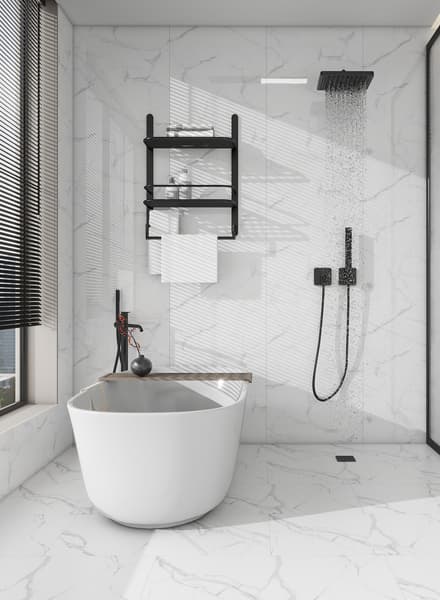
Architect-designed bathrooms of the last five years share one grammar: fewer, larger surfaces. Designers work with XXL tiles from 60 × 120 cm, or with full-slab natural stone — because an undivided wall reads as more valuable and visually enlarges small rooms. That exact formal language is what our SPC wall panels offer at 2.8 m height as standard. The wall reads as an architectural plane, not as a grid.
The difference is measurable: in a 4 m² shower bathroom, switching from 30 × 60 tiles to 2.8 m panels reduces the visible joint count from around 180 to a maximum of two horizontal seams. Fewer lines mean a calmer wall — and more room for the features you actually want the eye to settle on: a free-standing bath, a floating vanity, the brassware.
SPC Instead of Tile: What Lies Beneath the Surface
SPC — Stone Polymer Composite — is technically closer to engineered stone than to traditional PVC. The core consists of 70 – 80% finely milled limestone, bonded in a polymer matrix, giving it dimensional stability and compressive strength that conventional vinyl wall cladding cannot match. On top sits a photo-realistic decor layer under a transparent PU wear-layer with synchronised embossing — meaning the visible marble vein is also felt as depth texture.
Compared directly to classic PVC or soft vinyl wall cladding, this means three things. First, the panel stays dimensionally stable across the 10 – 40 °C range typical of bathrooms with showers and heated floors — no stress cracks, no waviness. Second, SPC carries a wear class approved for commercial shower environments. Third, the surface can be fabricated to crisp edges — a precondition for grout-free seams.
Three Decors That Replace Bathroom-Tile Aesthetics
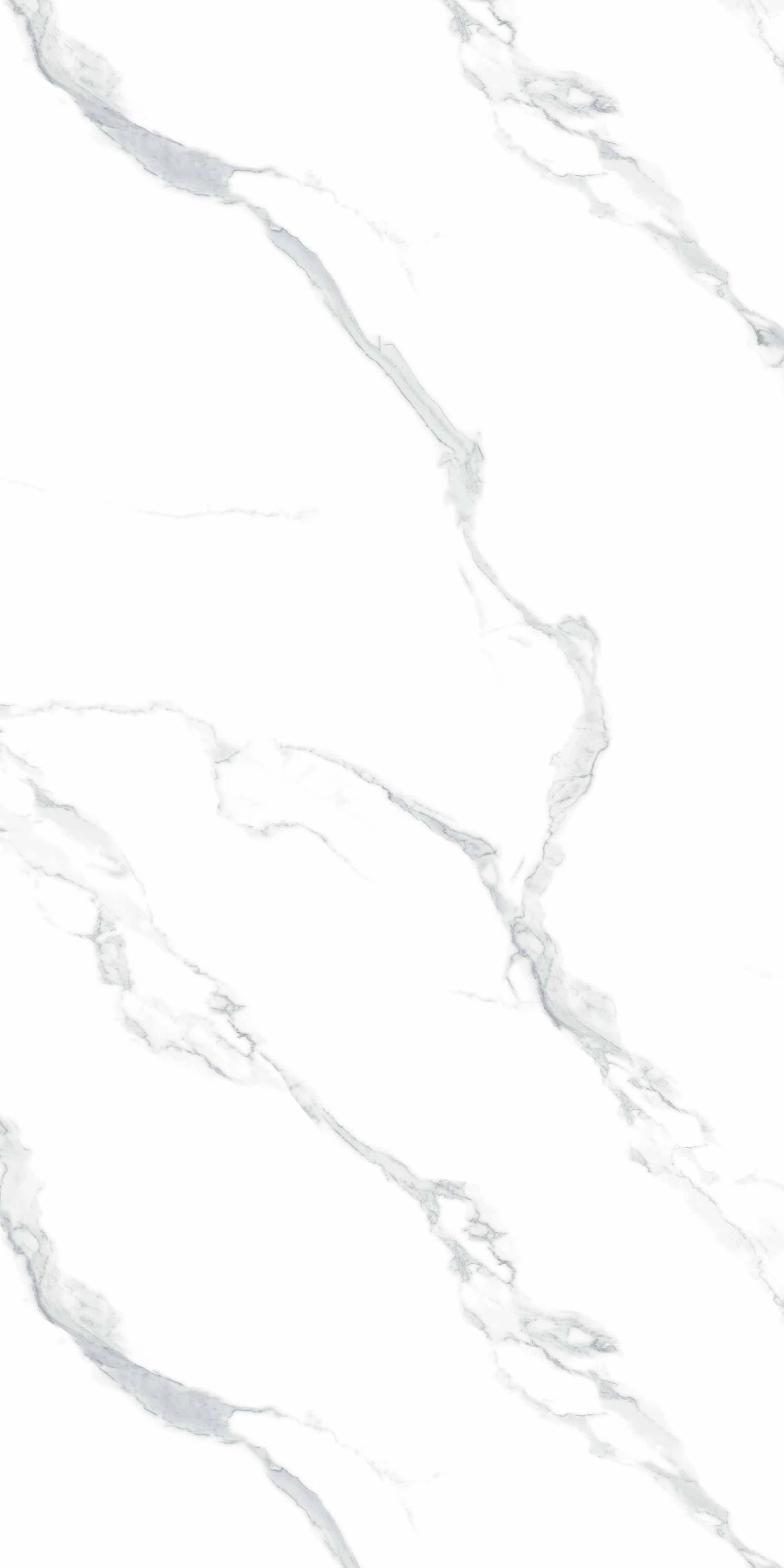
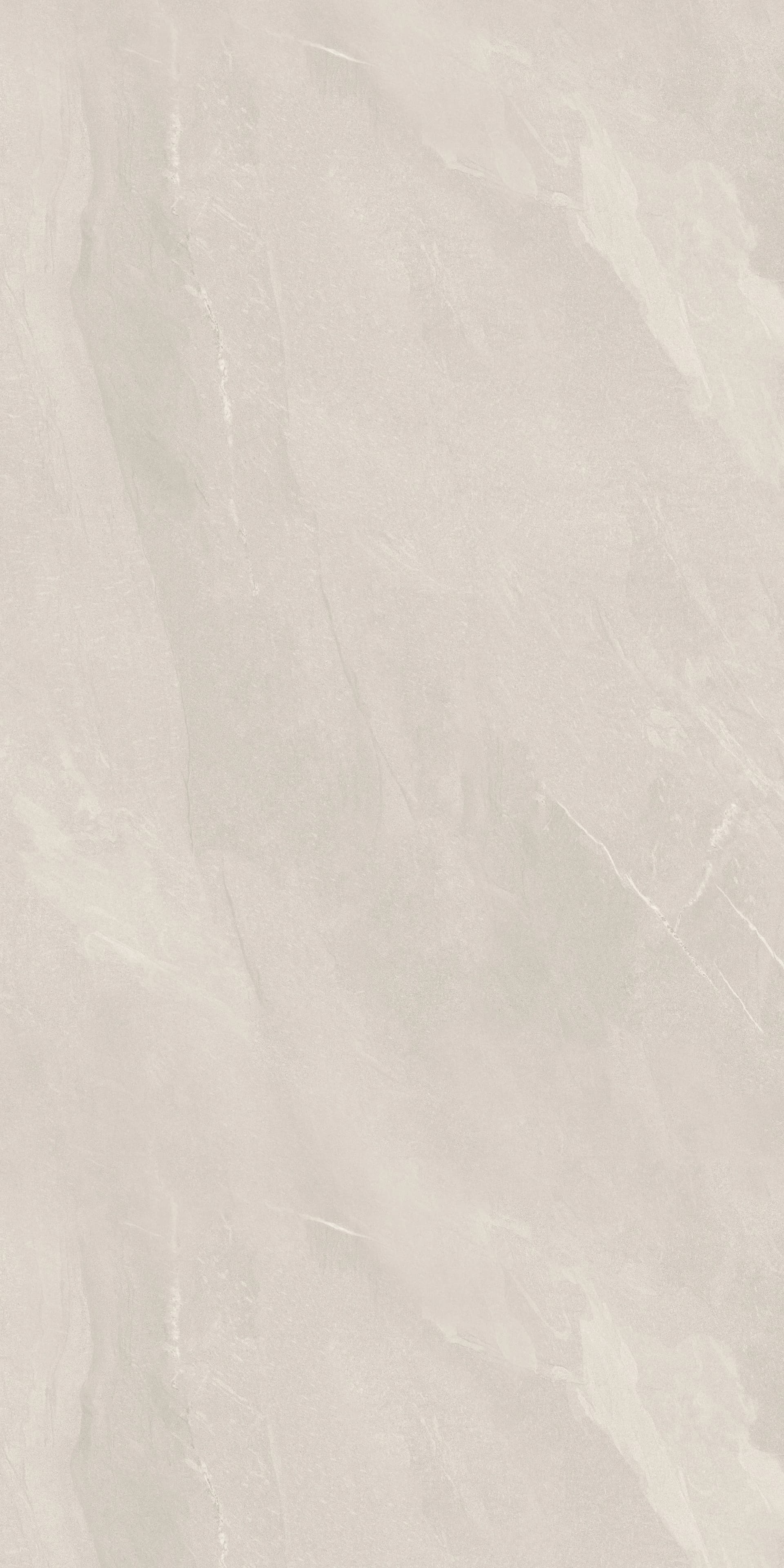
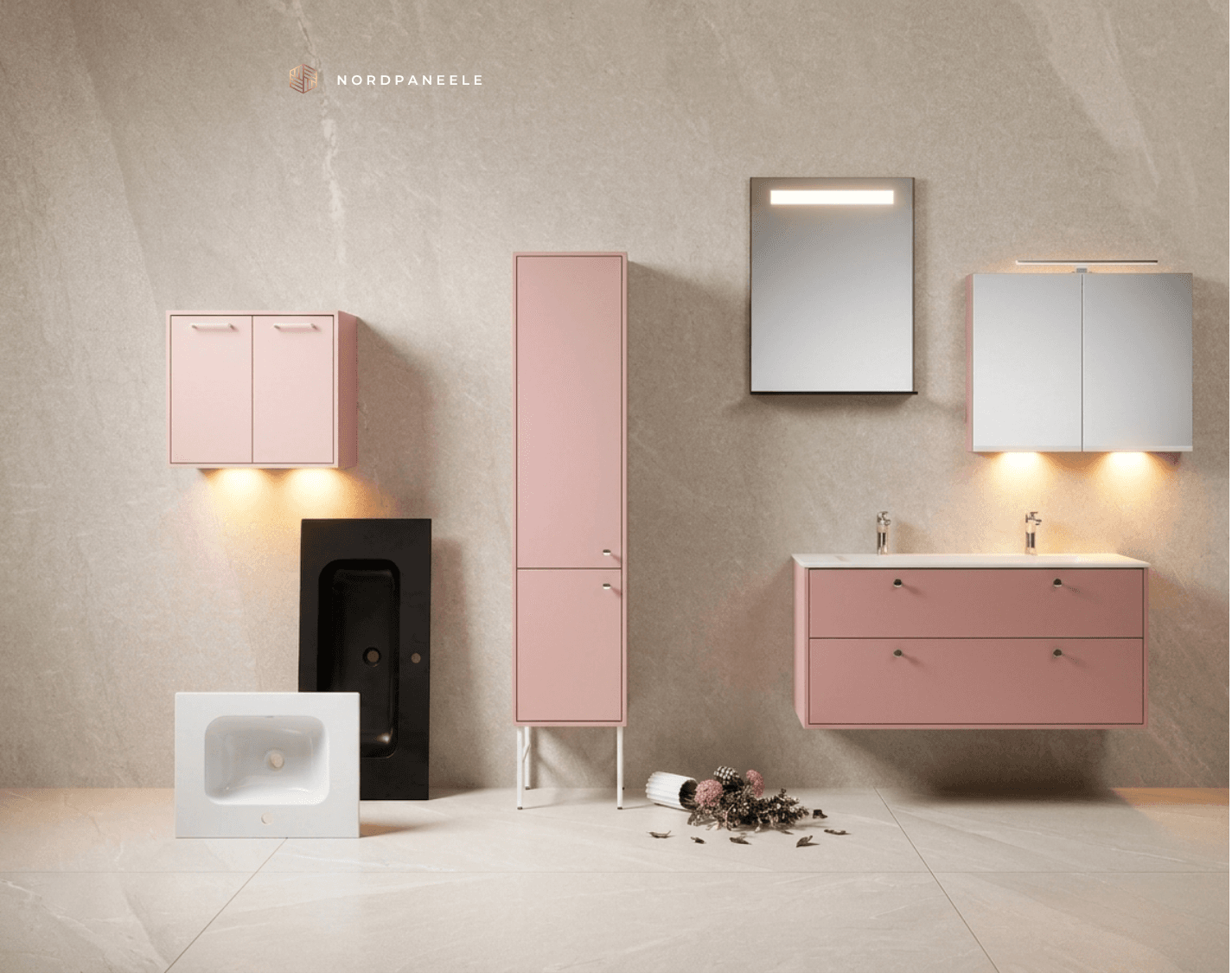
Carrara Bianco replaces classic white rectangular tiles with one continuous marble wall. Pietra Grigia plays the role of a neutral limestone base — the calmer, lower-contrast alternative to graphic large-format porcelain. Beton Anthrazit delivers the urban-reduced plane that used to require oversized porcelain slabs or real fair-faced concrete. All three are available in matte, non-glossy finish — the aesthetic favoured in contemporary bathroom design.
The three decors also work combined: the shower niche in Carrara Bianco, the opposite vanity wall in Pietra Grigia, a shadow-gap detail in Beton Anthrazit. Because panel height is consistent and the seams land precisely without tooling, material transitions can be planned without trim profiles — producing the kind of curated bathroom composition seen in architectural publications.